
Right place, right time...
Magnum Photos


[Logo: Magnum Photos - founded in 1947]
In the very first days of the Magnum Photos cooperative, a profound change took place in photography. One might even call it a revolution. Photographers who belonged to Magnum Photos changed the game for photographers. Instead of handing over negatives and prints to their clients, Magnum laid down new rules for doing business. Magnum Photos sold the rights to use a photograph once. And only once! Magnum kept the negatives. Single-use-only would change the game and power structure in photography.
This new way of doing business was the creative dream of a handful of photographers led by Robert Capa (1913 - 1954), who was joined by Henri Cartier-Bresson (1908 - 2004), George Rodger (1908 - 1995), Chim (David Seymour 1911 - 1956), and William Vandivert (1912 - 1989). These five photographers were photojournalists, they formed a cooperative. Magnum Photos was incorporated, May 22nd, 1947 in New York. The cooperative opened offices in Paris and New York.
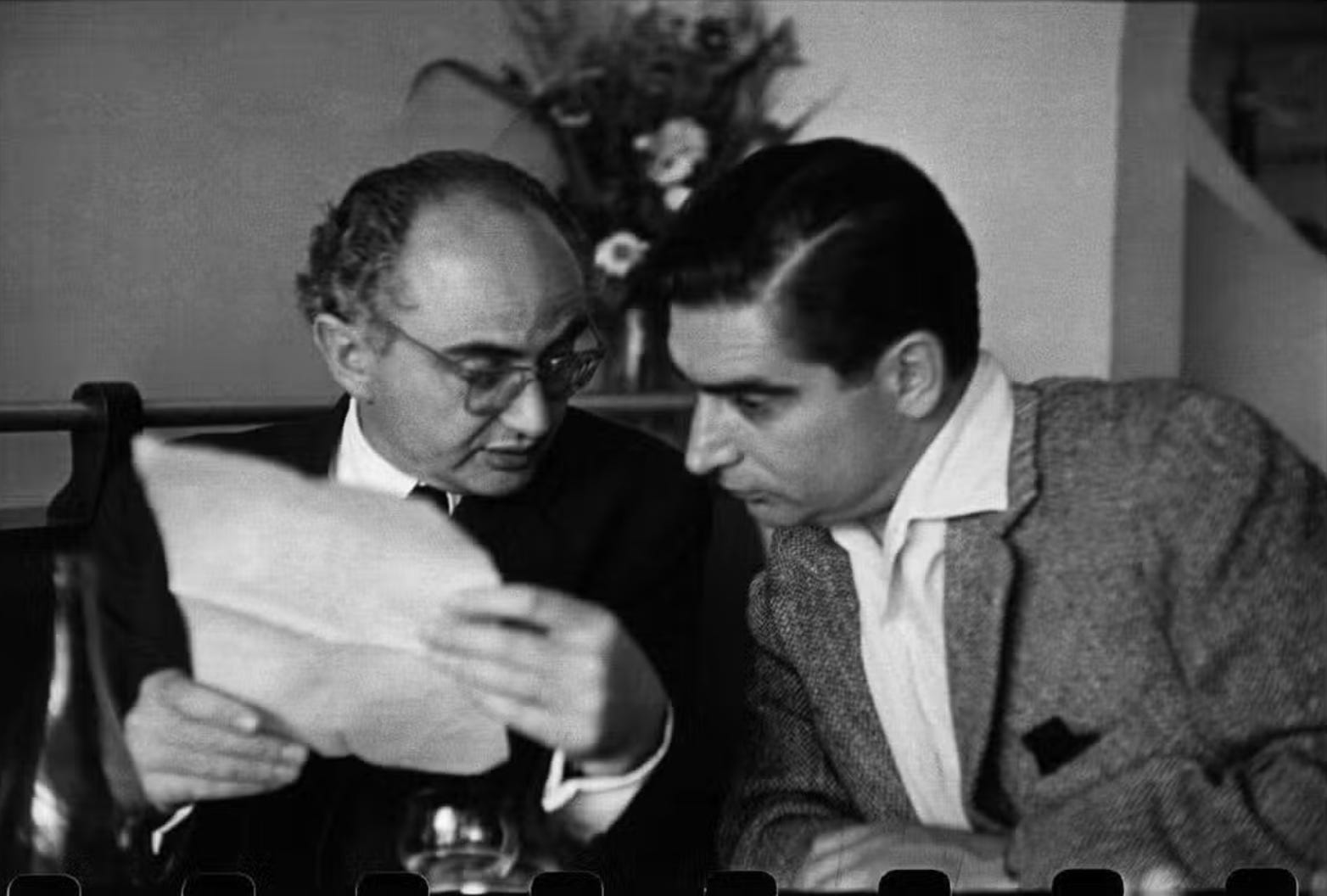
[Henri Cartier-Bresson: Chim and Robert Capa - Paris, 1952]
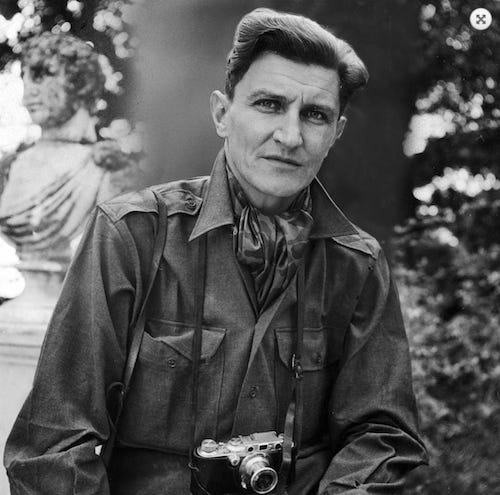
[George Rodger: Self-portrait? ca. 1945]
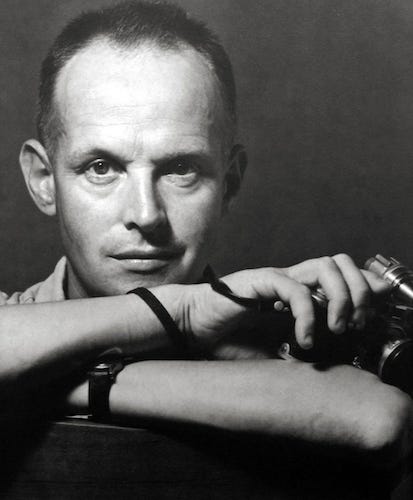
[Sam Tata: Henri Cartier-Bresson - 1940]
The five founding photographers at Magnum Photos divided the world among them: Cartier-Bresson would cover Asia; George Rodger would look after Africa and the Middle East; Chim would be in Europe; and Vandivert, who would leave Magnum the following year, was supposed to cover the Americas. Predictably, Robert Capa, who was a free spirit and hard to pin down, could roam wherever he pleased.
The photographers at Magnum Photos worked as a cooperative, using a financial model that would support and help each photographer focus on their area of interest. By pooling their funds, they shared the risks and rewards. Sales were initially mostly to illustrated magazines and the press. Later there would be books, print sales and exhibitions, even posters, postcards and the odd coffee mug.
I am sure you can imagine a photo-editor at a newspaper, or illustrated magazine having a very difficult time with this new Magnum Photos single-use-model. There was tension and a lot of animosity towards Magnum in those early days. The photo-editor at a magazine, or newspaper, could no longer control the use of photographs in their possession. They could no longer use them where, or when they pleased. They had to agree to buy a photograph from Magnum, and use it only once. A stand-off was on the horizon. However, things changed when timing and chance were on the side of Magnum in a way that no publication on earth could ignore.
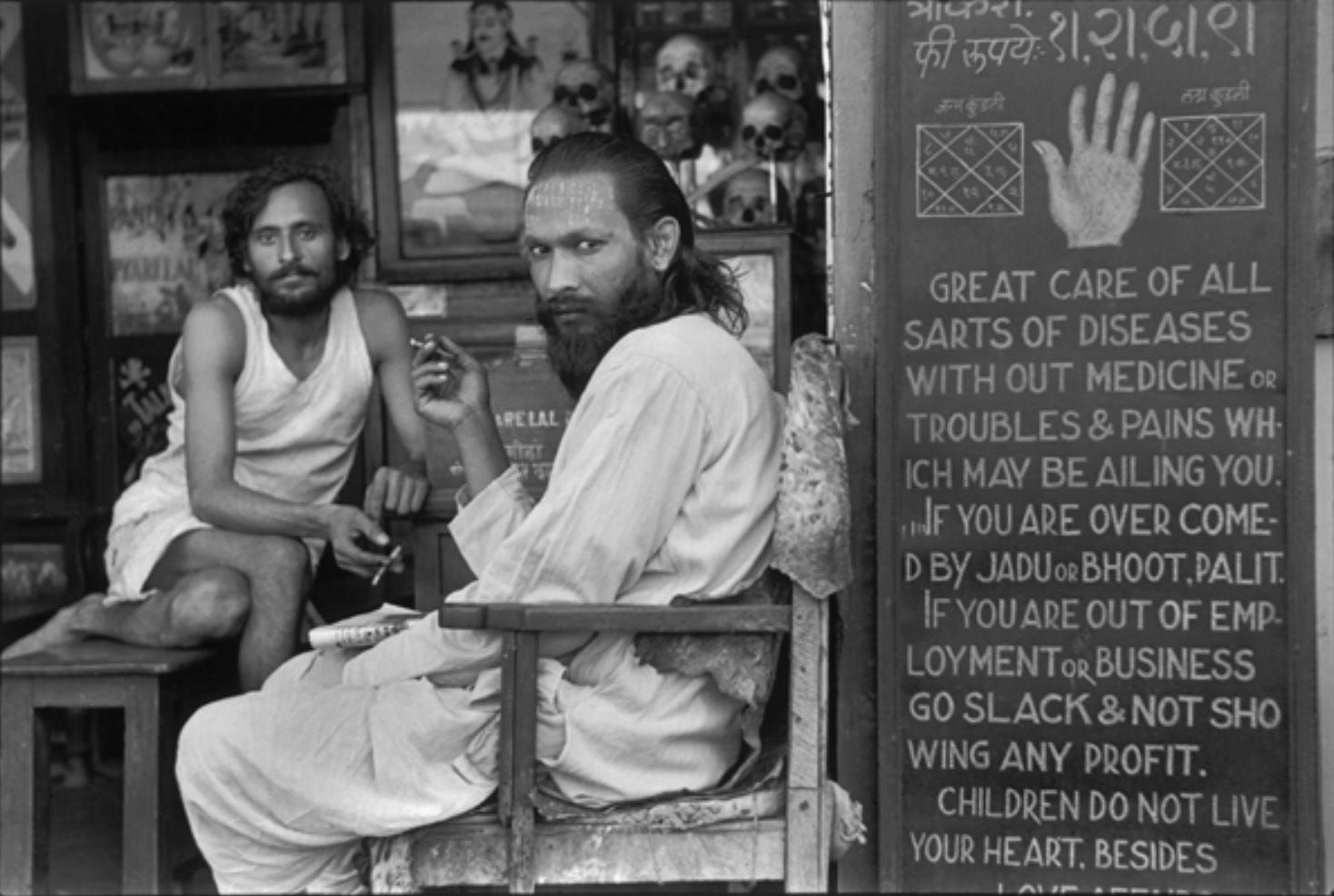
[Henri Cartier-Bresson: Astrologer’s Shop, Bombay, Maharashtra, India, 1947]
In the fall of 1947, the founding photographers set off in their respective directions and went to work. Henri Cartier-Bresson headed east, making his way to India. He set out to photograph the newly independent India. Once in India, he set himself the objective of spending some time with the great Mahatma Gandhi and making his portrait. Cartier-Bresson made the photographs and wrote his own captions.
His portrait session was scheduled for the 29th of January, 1948. Gandhi was the great conscience of India. A national treasure. He was very weak, as he had just broken a hunger strike to stop a series of riots, which had killed thousands across the new country. He graciously received Cartier-Bresson and let him hang around for most of the day, making discreet photographs.
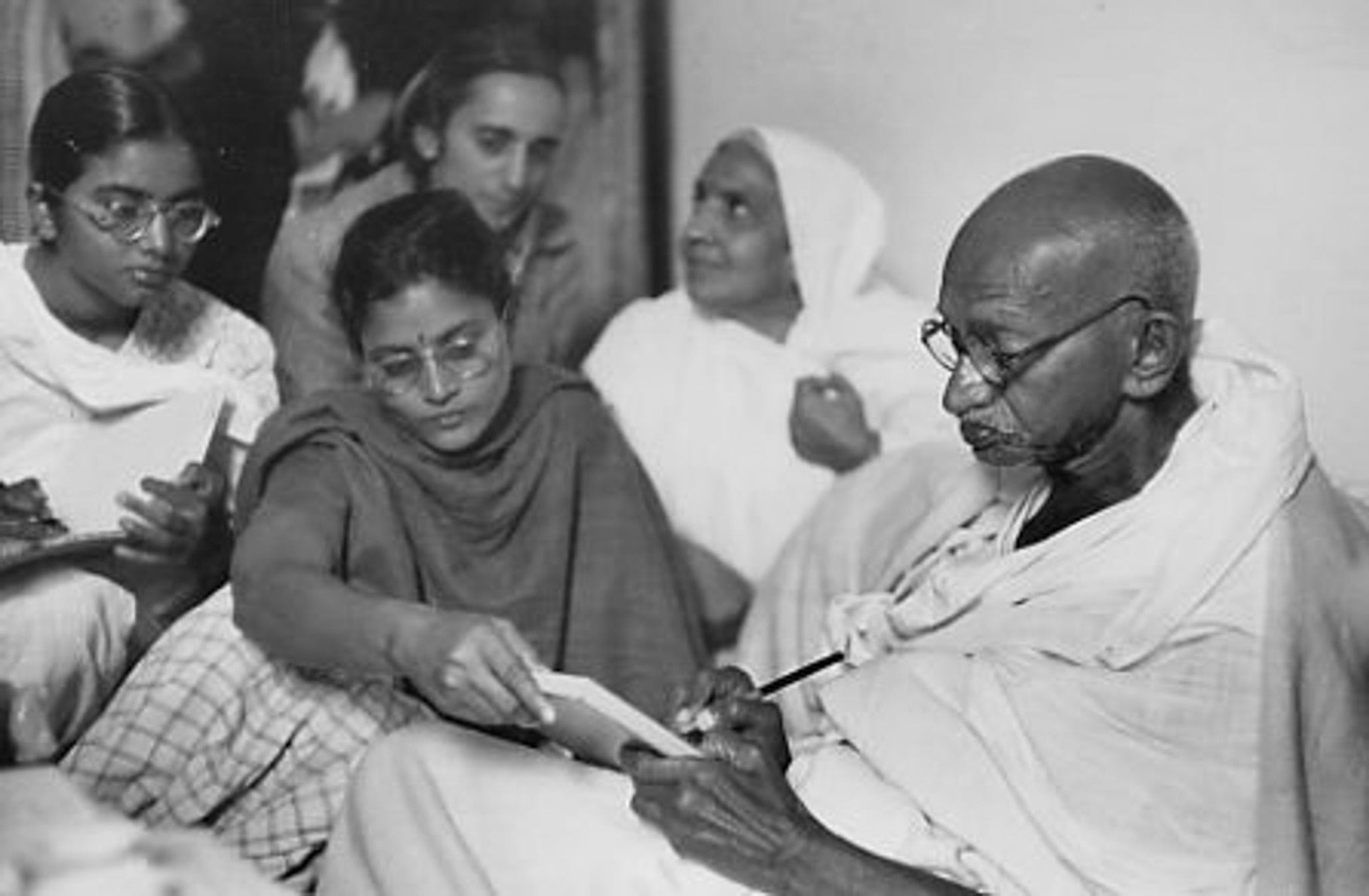
[Henri Cartier-Bresson: The Last Days of Gandhi - January 29th, 1948]
Cartier-Bresson wrote: “Up at Dawn and gaining strength, Gandhi all day receives a constant stream of visitors. Some are members of the Indian Government, but he talks with the ordinary Indians of all casts and of all sects. Here a group of survivors from the Gujerat train slaughter, in which scores of Indians were butchered, call on the Mahatma to tell their story.” (quoted from the slug on the back of the photograph below).
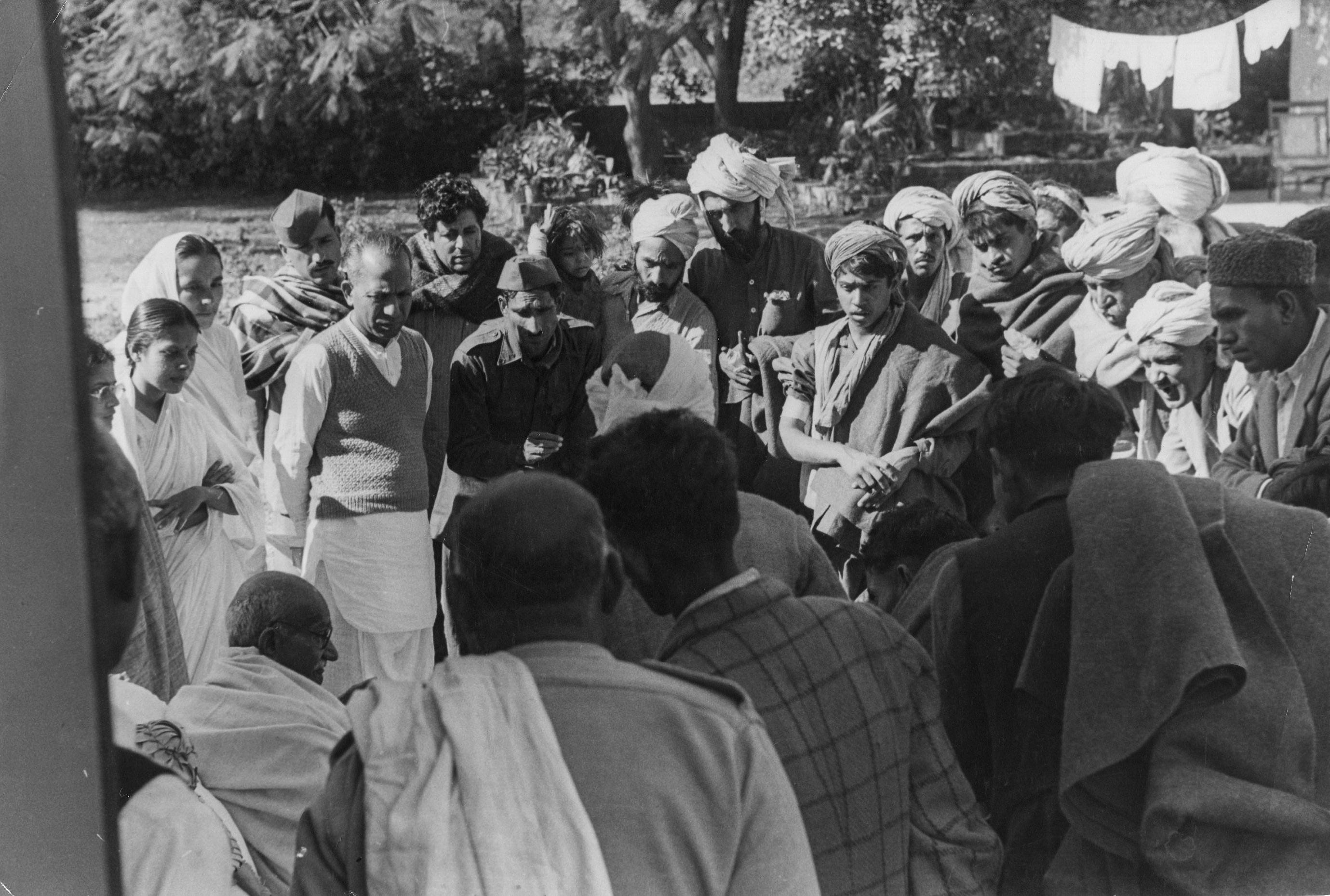
[Henri Cartier-Bresson: The Last Days of Gandhi - January 29th, 1948]
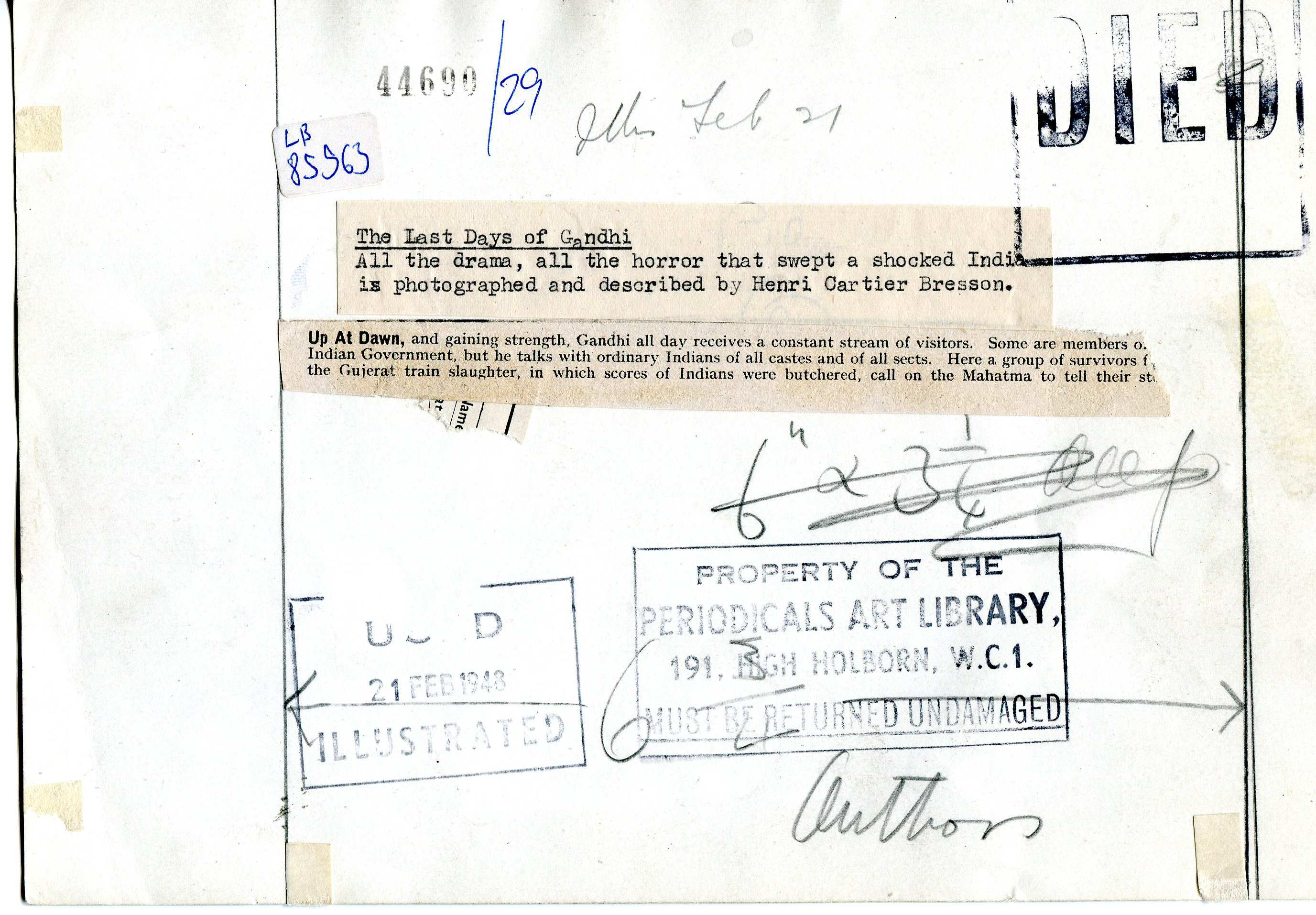
[Henri Cartier-Bresson: The Last Days of Gandhi - January 29th, 1948 - verso/back]
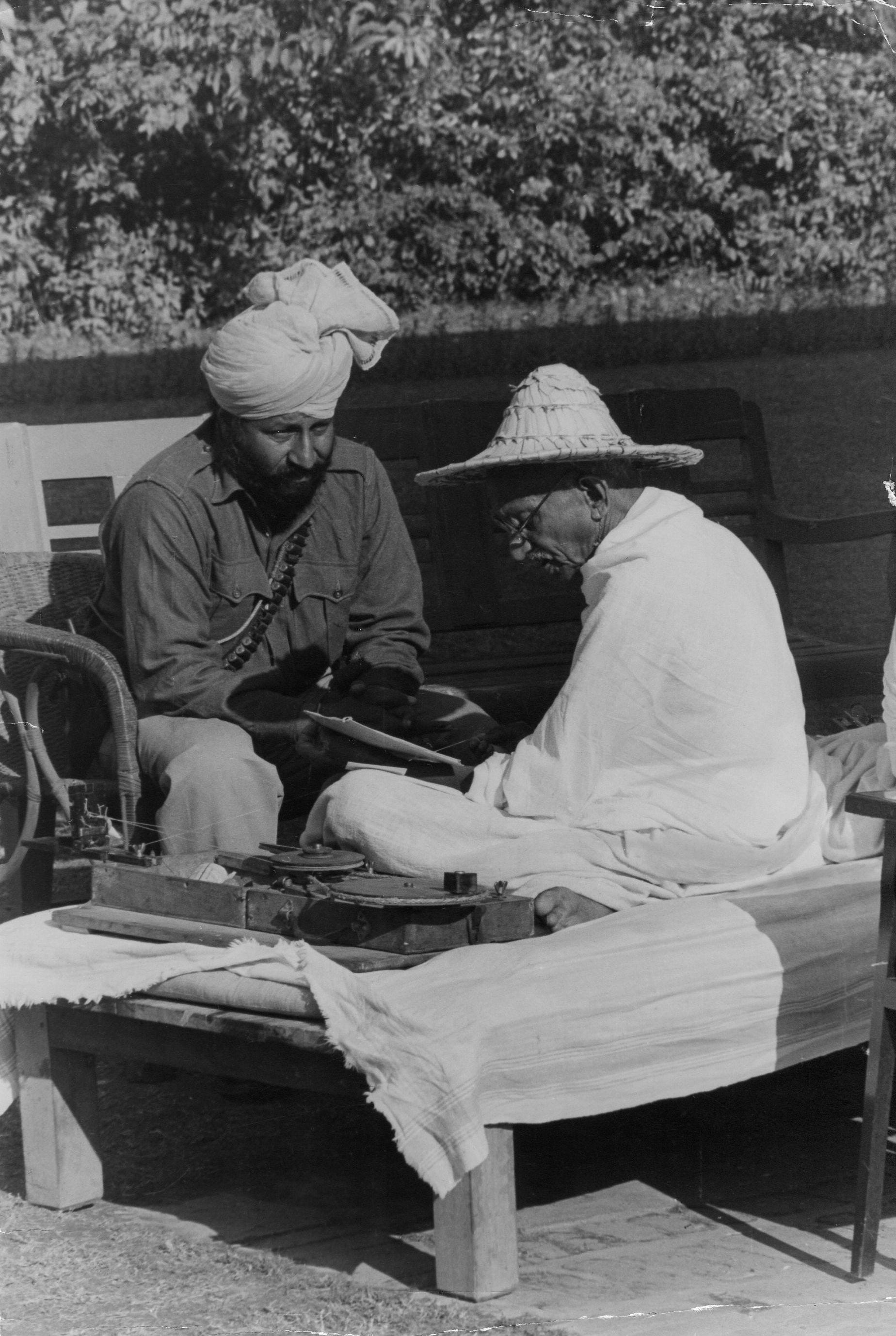
[Henri Cartier-Bresson: The Last Days of Gandhi - January 29th, 1948]
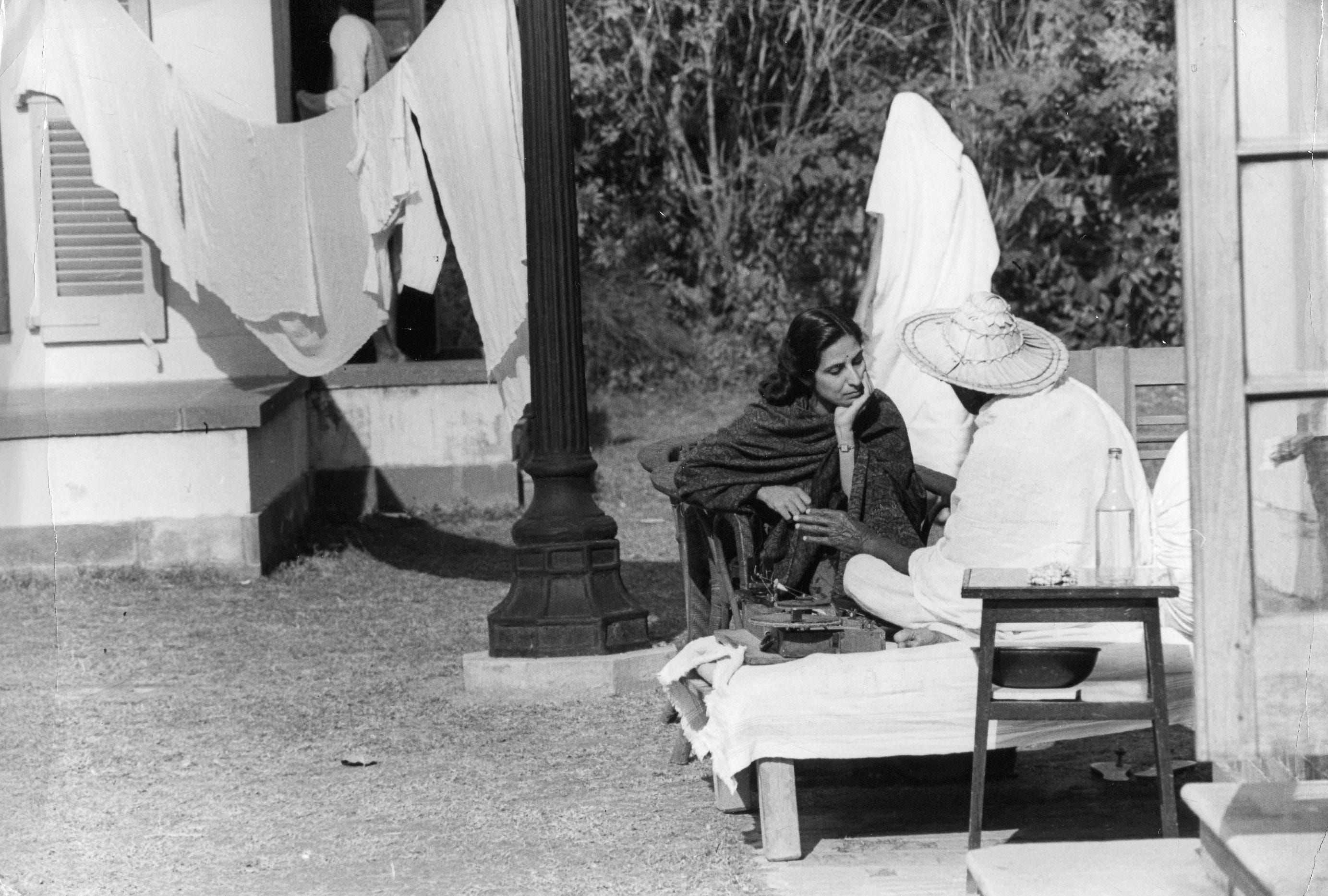
[Henri Cartier-Bresson: The Last Days of Gandhi - January 29th, 1948]
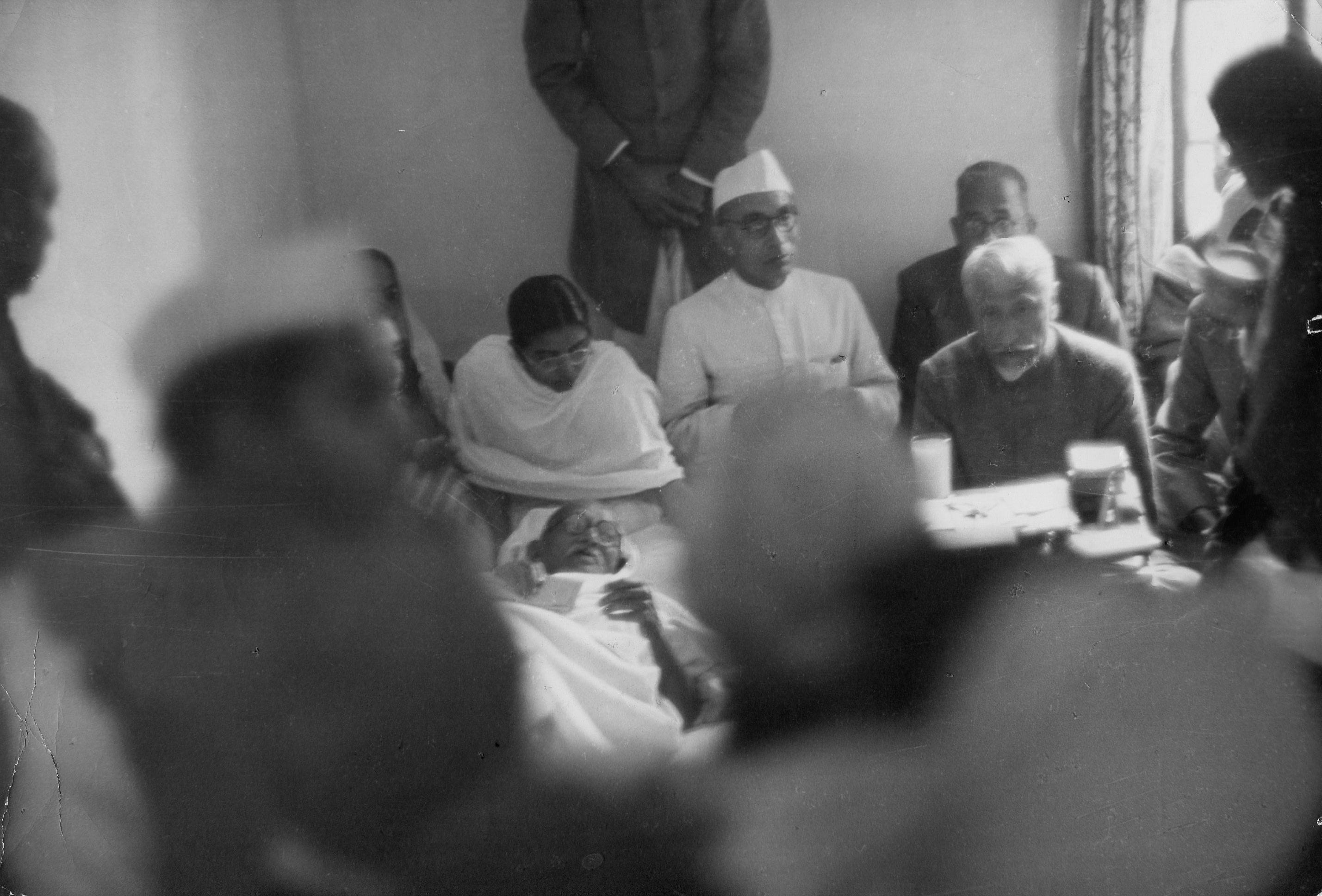
[Henri Cartier-Bresson: The Last Days of Gandhi - January 29th, 1948]
Towards evening, he made a photograph of Gandhi leaving a prayer meeting not far away. Cartier-Bresson thanked the great man and returned to his hotel.
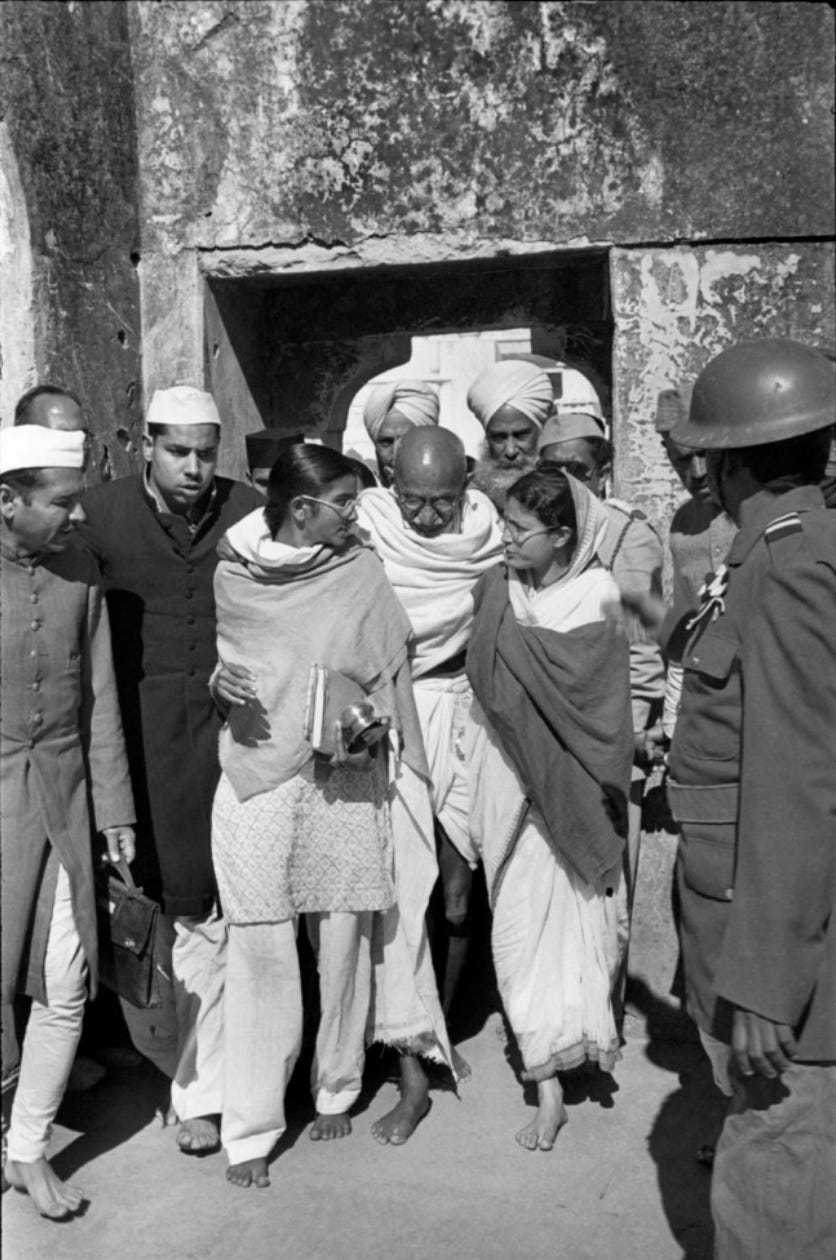
[Henri Cartier-Bresson: Gandhi attended by his two young attendants - January 29th, 1948]
The next day, January 30th, 1948, just before five in the afternoon, Gandhi made his way from his humble two rooms towards the street. Like every evening, a crowd had gathered to see the great man, who had only been seen a few times since breaking his hunger strike. He was supported by the same two women Cartier-Bresson had photographed the day before. The two young women had helped and nursed him during his hunger strike. One girl was his niece a couple of times removed, and the other a young girl the Gandhi’s had adopted some years before. Gandhi, just skin and bones, was weighed that morning. His tortured body weighed just over 110 lbs., or 49 kilos. He leaned heavily on his two faithful companions. Three shots rang out. Gandhi fell to the ground. He died within a few hours.
Cartier-Bresson had by chance been the last photographer to photograph Gandhi. On hearing the news, he left his hotel and returned to the scene to make photographs of the aftermath and the funeral.
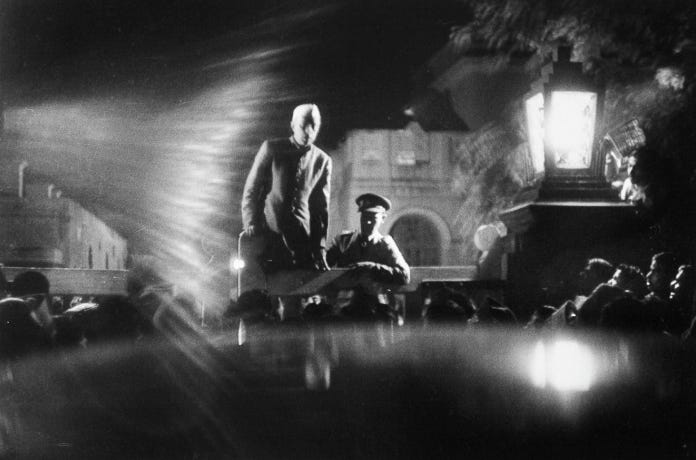
[Henri Cartier-Bresson: Prime Minister Pandit Nehru Announces to the crowds that the Mahatma has died - January 30th, 1948]
Here is the back of the Nehru photograph:
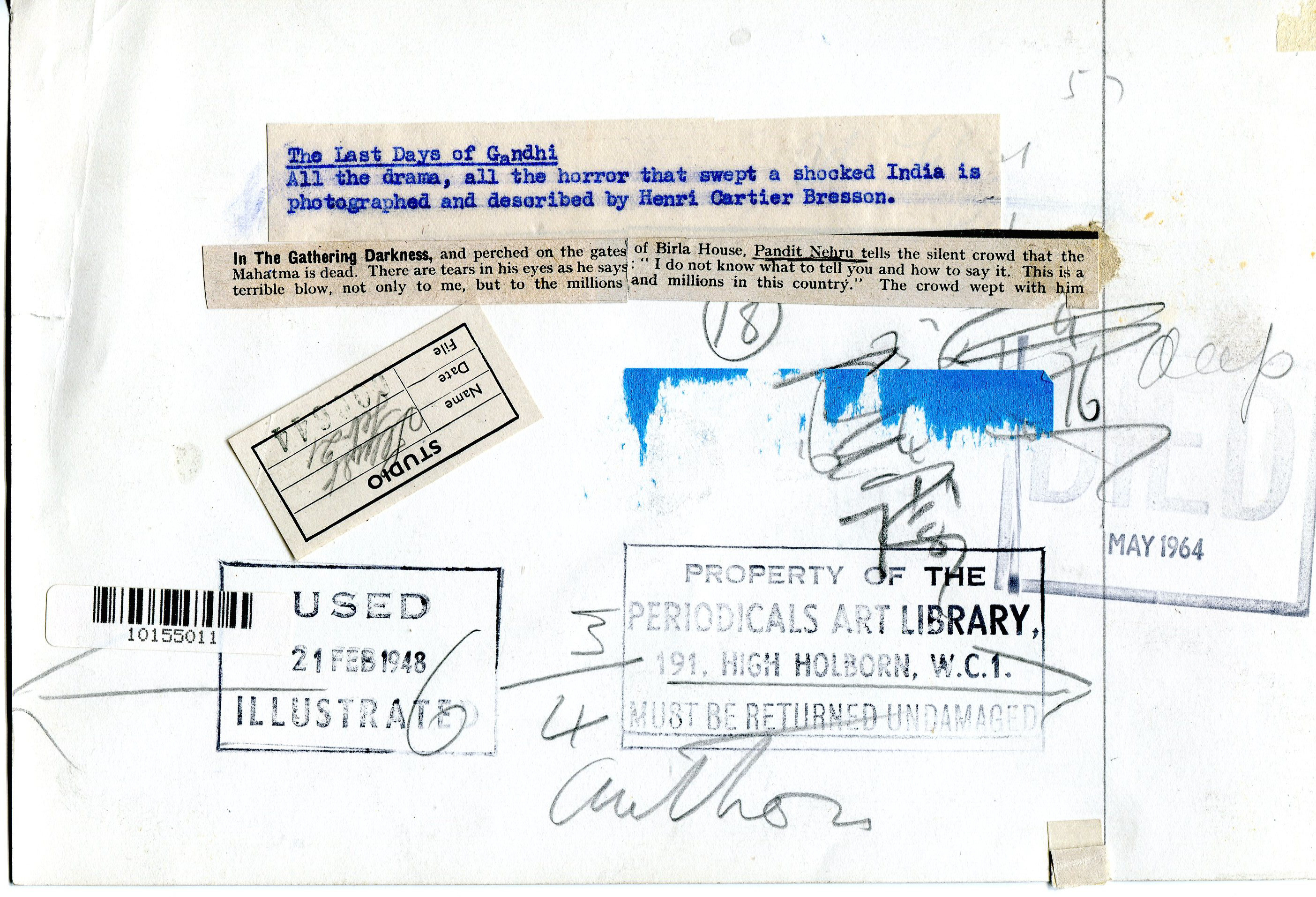
Among all the stamps and other information, we find Cartier-Bressons description of what he witnessed:
In the Gathering Darkness and perched on the gates of Birla House, Pandit Nehru tells the silent crowd that the Mahatma is dead. There are tears in his eyes as he says “I do not know what to tell you and how to say it. This is a terrible blow, not only to me, but to the millions and millions in the country”. The crowd wept with him.
The photographs and accompanying text literally flew around the world. They were published widely, including in the following issue of Life Magazine, as well as most every other magazine and newspaper you can name. Cartier-Bresson’s story and photographs could not be ignored. Magnum Photos was on the map. The legendary photographer added this slug to all his photographs from the series:
The Last Days of Gandhi: All the drama, all the horror that swept a shocked India is photographed and described by Henri Cartier Bresson.
Below this slug would be a second slug describing what was in a particular photograph from the series, as you can see in the examples above.
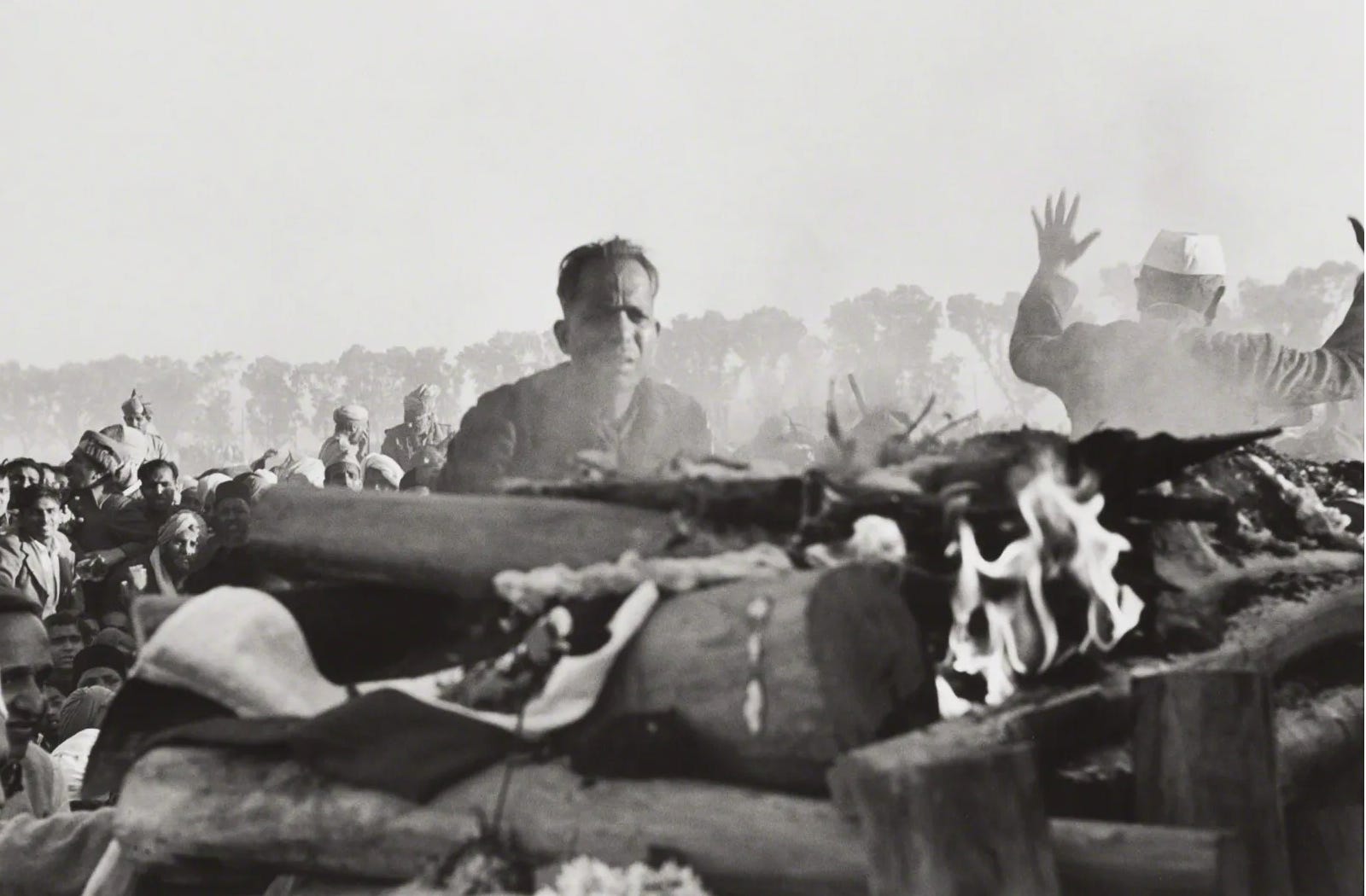
[Henri Cartier-Bresson: Gandhi’s secretary watches the first flames of the funeral pyre, Delhi, India - 1948]
The money from the sale and distribution of the single-use rights to the photographs made by Cartier-Bresson on the 29th of January, 1948 and the scenes which followed after the announcement of Gandhi’s death, secured Magnum Photo’s future. Magnum gained immediate recognition for their work, and overnight Magnum Photos became a viable business. The Last Days of Gandhi series by Cartier-Bresson helped cement his personal reputation as a photographer with impeccable timing, who was able to capture the decisive-moment.
Had Cartier-Bresson not been in Delhi looking to make a portrait of Mahatma Gandhi, Magnum Photos may well have fizzled out and been nothing more than a blip in the history of publishing. The Magnum single-use-only model is alive because nobody could ignore the photographs Cartier-Bresson made on the fateful visit to photograph Gandhi. Or at least, this is how I see it.
Photographers everywhere should be grateful for the successful Magnum Photos single-use-only-model. Many careers have been made, thanks to the five visionary photographers who broke the rules and came up with a better mousetrap.
Until next time….
Reading up on Cartier-Bresson, I learned, to my amazement:
"He acted in Renoir's 1936 film "Partie de campagne" and in the 1939 "La Règle du jeu" [1939; English: Rules of the Game], for which he served as second assistant and played a butler. Renoir made Cartier-Bresson act so he could understand how it felt to be on the other side of the camera."
"Rules of the Game" is often voted one of the best 20 films of all time. It's a masterpiece that I have watched, I dunno, over 30 times, but I never knew to look for C-B! Time to get out my Blu-ray disc of RotG and find C-B!
Thanks, Wikipedia:
https://en.wikipedia.org/wiki/Henri_Cartier-Bresson
Many thanks for an interesting and informative historical read!